Showing posts with label Learning. Show all posts

Thursday, May 5, 2016

LRNG Playlist – Critical Photographer


Photography is a passion of mine. It offers a chance to look back on what I did paired with a certain anticipation of future possibilities. Photography can also be a space of salvage. I return to the photographs to browse in expectation to stumble upon an abandoned image that can be rescued to underscore a message, to convey a mood in ways that were unanticipated at the time of capturing. During my Master’s Thesis, designing a video workshop for and with youth, I experienced the use of photography to explore everyday challenges and a way to imagine future, perhaps more desirable, practices. Having thought back on this experiences from time to time through my work on Open Portfolios, which centers around understanding portfolios as a tool for capturing, curating, and assessing the rich learning of youth making, I wanted to try to bridge my current work with that of the past.

Playlist Overview
My LRNG playlist is called Critical Photographer. It is an introductory taste to exploring, imagining, and remixing impressions through photography. Through hands-on engagement right from the start, 6 XPs invite youth to question possible meanings of photographs, extending the camera as a creative tool, showing different experiences of the same situation, documenting everyday challenges, and editing images to visualize desirable alternative realities. Throughout the XPs youth capture and share their work online and build a portfolio that could potentially become the basis for bolstering a job or college application.

XP 1: 99 Snapshots – Youth get started by clicking 99 snapshots of anything they like. They are asked to upload all of their photographs online and to write captions or hashtags for every picture. The amount of images is intentionally high for three reasons. First, youth get used to the idea that any situation could become a photograph, a story. Second, youth build a repertoire of work as the basis for other XPs. Third, youth take a second pass at their work to get them to question photography as representation of one true reality.

XP 2: DIY Filters – The visual effects a camera can achieve is endless. Exploring the physical tool is one way to find out about this versatility. In this XP, youth question the fixed nature of the camera by creating DIY filters with everyday materials, such as cellophane foil, orange nets, and tape. The idea is for youth to see the camera as a playground for innovation, that can be added onto. The ideas explored here can expand the productions of later XPs by incorporating diverse visual effects.

XP 3: Petite Picture Plots – Photography can be a powerful tool for storytelling, underscoring emotional messages or highlighting key turning points. Expanding preceding XPs, youth select a limited amount of photographs from their repertoire and create three short stories by arranging and curating the same images in three different ways. Youth explore position and narrative order to produce nuanced alternative meanings.

XP 4: Rediscovering HomeReturning back to a space youth are connected to, youth view the place from two new and contrasting perspectives, for example from the perspective of a tourist and that of an artist. Youth consider what photographs by tourists and artists might look like and how they might contrast and select angles and subjects to represent. In the process, they create images that represent different possible experiences of the same space, and explore how to document them photographically.

XP 5: Empowering Photography – Building on the preceding XPs, the last XP before the Capstone is about identifying everyday challenges and envisioning more desirable alternatives. Youth explore a public space, document a challenge photographically, discuss the photographs with friends and/or family, and edit the photographs to represent a more desirable situation. The youth question the use of photographs as solely documentarian by crafting photographs that serve to imagine possible futures.

Capstone XP: Photography Portfolios Having documented and captured their work throughout each XP, youth take another look at their repertoire of work. They curate their work for a specific audience, such as their friends, their family, or college admissions, and to highlight the work that is most meaningful to them and the work they think might resonate well with their audience.
Design Process Highlights
The written format of presenting design processes calls for linear representation, distorting some of the criss-crossing that often takes place in design. In the hope to preserve some unintentional tangents, I highlight three examples that shaped my playlist unexpectedly:
Once I settled on a theme, XP ideas started flowing. Of my 15 ideas, only 6 made the playlist. To decide which, I wrote short descriptions for all 15 XPs. The main idea crystallized into one hopeful learning outcome: visual questioning. I held onto this message as I made cuts. Along the way, I lost ideas, such as (1) Locating Legends, an XP for  youth to research photographers online, and (2) Capturing Characters, an XP for youth to capture creatures and faces that hide in everyday objects. Even with a very concise list of XPs, possibilities seemed endless. Each XP could be complexified into its own playlist. Consciously not overthinking helped keeping it simple.
As I cruised around the website, I design for speed. I discovered that I could underline text to highlight the essentials, facilitating quick reading. Applying this across XPs, this strategy became a way to explain away concerns about my Show and Proof. All of these written with consistency, producing coherence, minimizing reading time, and introducing familiarity. I liked the idea of inviting youth to build up their capstone along the way.
Knowing that other things would be on my plate, I wanted to get my playlist out of the door ASAP. When I published my playlist I realized that no further edits were possible. Feeling o.k. about my playlist, besides the many spelling mistakes, I wonder how intentional this design choice was. I understand that the badge needs to be connected to a stable playlist so that the badge can remain meaningful for the youth who earned it (e.g., earning a badge might mean that its holder can do the things the playlist asked for, but might not be able to do the things a revised playlist might ask for). – Designing around badges and with in mind seems tricky. While powerful, badges seem to lock in design processes and create overhead.

Theory-based Design
The Critical Photography playlist is production centered. Youth create photographs, camera attachments, imaginative collages, and a portfolio of the work they feel good about and would like others to see. The documentation of work is at once a way to keep track of and remember the amount of work and thinking done, a way to share rich learning experiences with others, and an invitation for youth to broker new opportunities and new connections. The optimistic gesture towards the future is by design. The playlist was designed based on Connected Learning that emphasises production-centered, openly networked, purposeful creativity with interest and peer driven learning (Ito et al., 2013). Emphasizing open and public sharing of work, the learning of Connected Learning is intended to foster personal development and a collective shift (Ito et al., 2013). This is particularly predominant in the XPs, where youth look sideways to see familiar spaces in new ways, notice things about the spaces they had not seen before, and identify alternative ways of doing.

Photographs can shift in meaning over time be it by looking back at a snapshot or re-mixing or narrating a large body of work. These engagements can surface the layered ways of photographs: An image can be blurry one day and on another funny or tragic. The XPs are sequenced to complexify possible uses of photographs. This way the photographs and the camera are encouraged to become objects to think with, inviting youth to document, explain, and imagine. The creative practice with the object can surface new ways of understanding the world and can help explore what it means to know and how knowing comes about (Papert & Harel, 1980). With an object to think with, anyone can engage in epistemological work (Turkle, 2007). This very much connects the playlist also to material feminist approaches to learning and design for learning. Material feminist theories consider that the sense-making instrument that detects a phenomena (Barad, YEAR), e.g., the microscope in biological research or the camera in the LRNG playlist, have a way of shaping the way in which the phenomenon comes about. This dynamic shaping means that there is always necessarily a multiplicity of realities and that the person behind the camera and the camera itself shape how these realities can be perceived, read, and made meaningful. While not explicitly referencing such complex theories, the Critical Photography playlist was aimed at inviting youth to think about underlying assumptions of what reality might mean to them and how the camera work can shape and shift the way reality is documented and put back to work.


Thursday, April 14, 2016

Playing with others and a Makey Makey board

Our emergent group making music by forming a human circuit with the Makey Makey breakout board, bananas, a 3D printed elephant, and a computer.
Makey Makey is a breakout board that, when connected to a computer via a USB cable, can act as a powerful tool for exploring conductivity and transforming everyday items into tangible interfaces that can interact with the computer screen. Exploring the Makey Makey in the MILL makerspace together with the other course participants was plainly fun.

This time, I took a much more communal approach to making, something that perhaps is not my first inclination when getting started with a project. This shifted how projects were presented on social media: while previously projects took center stage in the photographs (see photo left), this time the smiling group was the focus of the picture (see photo right). The switch in going about making also highlighted ways of thinking about being in the world that seemed to be backgrounded through other approaches.

My first learning companion in this activity became the friendly blue 3D printed elephant that was laying on the table. I picked it up and taped conductive tape to its belly and trunk. My idea was to make interactions playful and to make screen movement happen by completing a circuit with my hand wrapped around it's belly and the elephant's trunk touching a conductive surface connected to the circuit. I walked around the table holding my character, looking for a project I could jump in on.

Someone left a keyboard attached to a Makey Makey on the table. I tried to connect to it. When it did not work, I did not do what I paused and turned away from my usual approach: tinkering with the materials to understand how it works. Instead I turned to the person next to me to ask for help. They happily showed me how to connect to make the keyboard project sound. I wonder how much of asking for help and putting others into a position of helping plays into being a valued part of a community.

With my new knowledge of how to make it work, I changed places and moved to the other end of the table, where two participants were working together on a banana piano. I placed my elephant next to their project and stepped away to see what happened. Almost immediately, one of them picked up the elephant and integrated it into their explorations. After some eye-contact and exchange of smiles, we formed a human circuit. One person held the ground, the other the elephant and we became connected through the person in the center. All three of us had a blast trying to make songs on the bongos. Our laughter seemed to attract others who watch us and asked questions. This is when the picture above was taken.

Taking a different, more social, approach to learning and material exploration at this point of the course seemed to highlight playing much more than any of my prior explorations. Much less serious and directed, this change of doing felt much more trusting in the space, the community, and the material and made me think about the kinds of things that can be missed when approaching making the same way again and again. Switching things up, bringing in new aspects, backgrounding others seemed to highlight ways of getting to know the world and being in the world with other that seemed previously not accessible.


Saturday, April 2, 2016

New Materialism: A very Quick Exploration


My e-textiles project: a soft reading light. 

This week was not the first time I created an electronic textile project. I made the project above out of four felt pieces, conductive thread, an LED and a battery pack. To avoid the thread from showing on the felted material, I sew it slightly under the surface of the yellow material. As the material was not very thick, it was still possible to see the dark silver colored thread beneath the surface, which created an interesting but unwanted visual. So, instead of sewing the purple felted piece on the other side of the project, to create a pocket, I added the rose colored felt circle on top of the yellow piece. While I initially intended to cut out a few additional circles to add more color to the project, I was charmed by the character that emerged out of the simple two-color combination. – I left the piece as is. 

Inspired by Taylor and Ivinson (2013) call for a focus on human and non-human bodies within education, this weeks' class was all about New Materialism. New Materialism is a theory and philosophy that rejects the subject/object split and suggests that matter is entangled and “conditioned by culture, history, and place” (Taylor and Ivinson, 2013).  In all of this entanglement of matter, knowledge is considered meaning-making within matter and cannot be separated from it (a key to accepting this is the fact that everyone and everything has a body. 

This introduces the curious idea about agency, which, contrary to a humanist perspective that ascribes agency to people, is not owned by anyone or anything. In New Materialism, agency comes about in uncertain ways through the way in which matter intra-acts (again action within). Here, it seems helpful to imagine the tiny weeny particles we are all made up of and when zooming in closely it is really hard to see where one matter ends and another begins. So New Materialism suggests that there are no definite boundaries between human and non-human, or human and human, or non-human and non-human matter. The boundaries are made are being made all the time as action unfolds. 

This is exactly why Taylor and Ivinson (2013) want us to question "which matter matters in educational situations". When we realize and remember that boundaries (and materials that catch norms and objective them, i.e., making it as if they are not to be questioned matter of facts) are created, we not only get a whole new meaning of what objectivity is, but we can also start asking how the boundaries are being created and how conditions that are called for by matter around us can be broken out of. This is huge and really productive for education and especially for maker education, because it means that (a) we can empower children by letting them explore and discover how they can make and un-make the matter around them (e.g., through toy-hacking, electronic take-apart tables, digital remixing, 3D printing camps, laser-cutter workshops), and (b) we can make better choices about how to design equitable, just, and ethical learning environments. 

One really neat example of a powerful design for learning that can bring about new ways for making and unmaking identities and agency in STEM fields are e-textiles, electronic toolkits that make use of needle and conductive thread to create soft electronic circuits that could be sewn into any fabric-based material. In fact, Buchholz, Shively, Pappler, & Wohlwend (2014) found that use of e-textiles materials “ruptured traditional gender scripts around electronics and computing”. The authors explain that the term gendered scripts refers to the uses with and access to materials that call for conducting recognizable and socialized gendered practice (e.g., in dyads of one boy and one girl, girls performed hands-on leadership roles in the e-textiles project). Buchholz et al. (2014) call to take on responsibility for the created gendered scripts/histories of materials, and suggest that introducing changes to materials can increase leadership opportunities for women in STEM. They warn against “cultural deficit model”, and call for educational STEM materials that allow performance of electronics practices and leadership roles in many ways.

As for my e-textiles project, these ideas were not as powerful. However, there are two simple intra-actions that seem worth pointing out. The most obvious of them is perhaps the way the idea of a soft reading light came about. When getting the project ready to photograph for this blog post, the kitchen table was cluttered with books, papers, and a broken night-stand lamp that I have been meaning to repair. When resting the piece on a book, I noticed that it illuminated the letters, and I thought that it was nice to frame the piece through this "useful" angle. The broken lamp in the periphery seemed to have added the theme of reading in the dark. Another intra-action that seems interesting to point out is the way the thread, the felt, and my wish to hide the thread lead to placing the rose colored piece of felt on-top of the yellow piece. This lead to reimagining the character of the project and reassessing the direction the project would take. 

Thinking with New Materialism as compass for design opens up new ways of thinking with matter around us, and perhaps new understanding of what it means to be a learner. I think that this theory can be a productive way to reclaiming power over one's own actions and making much more informed decisions in terms of the actions opened up or denied to youth. 

Monday, March 28, 2016

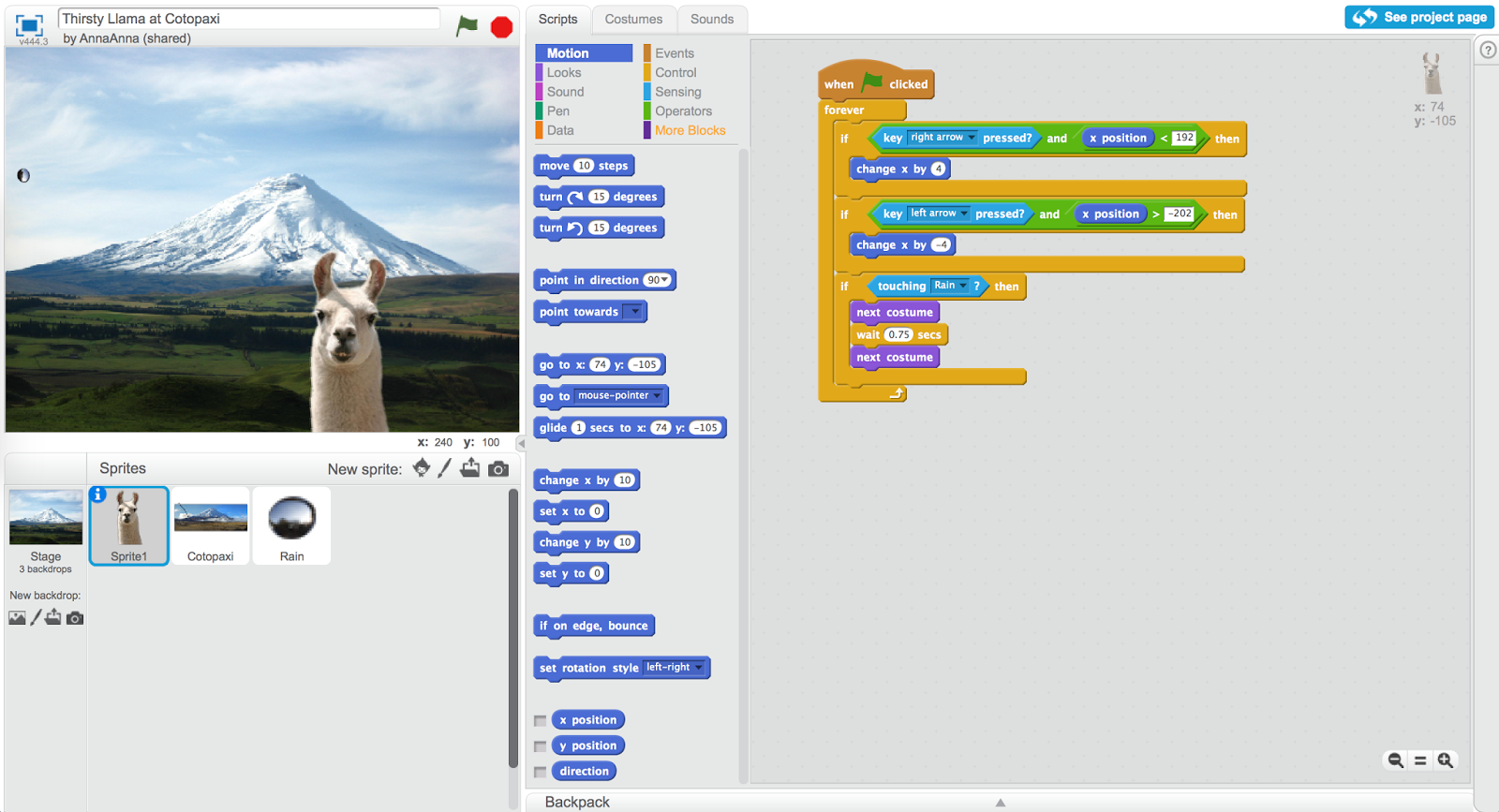
Thirsty Llama at Cotopaxi – A Scratch Project


To start, click on the green flag. Then move the Llama with the left and right arrow keyboard keys. When the Llama touches a raindrop there is a popping sound and the Llama smiles. Unfortunately, the Llama is picky and does not smile at each rain drop.

After opening the Scratch community website, logging into my account, and starting to ponder about which project to make, one particular project instantly caught my eye. It was called Hot Air (a game) and it was listed in the "featured project" section on the front page, center screen. Hot Air showed a green island in blue water with a hovering hot-air balloon. The simplicity and clarity of the graphics, clearly contrasting other featured projects, pulled me in. I clicked on it and tried it out. Underscoring its graphical clarity, the project also had simple and straight forward inter-actions. Up, down, left, right keyboard arrows moved the hot-air balloon, and the aim of the project was to avoid seagulls that entered the screen from the left and right side. There were also two numbers on the screen. A counter kept track of the seconds I managed the "stay alive", and a fixed number seemed to indicate the longest amount of time anyone every managed to "stay alive".


What further attracted me about Hot Air were the enthusiastic notes the creator left in the comments section, for example: "22/3/2016 FEATURED 2nd time!!! I won't be able to reply to most of your comments. DON'T ADVERTISE!!!!" The note communicated the excitement of the creators of being highlighted, their felt responsibility to connect with anyone who reached out to them, and a realization as well as apology for not being able to meet all requests for the creators' time. By writing "don't advertise" the creator seems to asked people to refrain from further sharing. And the comment seems to imply that the curator is of the impression that the felt added responsibility is a result of the project being featured.

The enthusiasm connected with responsibility to the other Scratchers paired with the simplicity of the design was fascinating to me, so I decided to try to make my own project inspired by this project. Since I am not an experienced Scratcher, I wanted my first shared project build up from the bottom, rather than remixing existing projects.


The code of Hot Air next to the code of my project.

The island looked much like a mountain, and I remembered my recent visit to Ecuador. During my first visit to Quito, one of the surprises I experienced was that a volcano was visible from the city. The Cotopaxi is an active volcano located close to Quito, the capital of Ecuador, and is part of the Pacific Ring of Fire. This experience inspired me to use a photograph of the Cotopaxi as backdrop for my Scratch project. I decided to replace the hot-air balloon with a Llama, mainly because Llamas are likely to live close to the Cotopaxi, and because they are friendly animals. My plan was an elaborate project in which the Llama would change its looks when hit by a rain drop and after being hit 3 times the game would be over, much like the Hot Air project. However, the coding of the project was more challenging that I imagined. Especially after seeing the code of the Hot Air project, which made use of many variables and even its own built blocks, I decided to simplify.

The popping sounds I added to the Llama when touching a raindrop changed the entire narrative of the project. It was such a satisfying sound, that I decided to give the Llama a grateful expression when it touched the raindrop. Changing the costume introduced a bug into the software. While a popping sound is produced every time the raindrop touches the Llama, the Llama does not change its appearance every time. I tried to resolve the bug by going through some of the tutorials that were conveniently available on the left of the screen. Eventually, I gave up on trying to fix it and changed the narrative of the project to feature a picky Llama that is not satisfied by every raindrop.

While working on the project, the way in which the active community, the featured projects feature, the see inside feature, and the tutorials came together and informed the development of my project was fascinating. Exploring the grammar of the language itself made me think of the many different ways I could have continued to expand the project. The community features helped me get inspired and generate idea for getting started and to persevere. The tutorials helped me get unstuck. While everything was mostly easy to get to, I created my own drawing board or pallet and through-lines on the site that I was at times challenging to keep present, e.g., opening up several tabs of the Hot Air project to be able to flip through codes more quickly, or opening up the tutorials in one tab while working on another. This made my wonder what an analysis of the intra-actions between Scratchers and the Scratch website might tell us about aspects of the sites to further expand the rich learning opportunities of the community.

Monday, January 18, 2016

Learning by Loosely Joining Pieces


Sometimes representations of how learning happens show different aspects of the phenomena of learning in concentric shapes with a strong emphasis on iteration and connections among aspects. In the photograph above, I illustrated learning by building on the metaphor of loosely joining pieces to represent an idea of learning that is makeshift, precarious, and highly idiosyncratic. Makeshift means that this idea of learning highlights flexibility to move things around. Precarious suggests that pieces are just holding together tight enough. Idiosyncratic refers to learning being unique for each person at a particular time, in a particular environment, and with particular people. This does not limit learning to happen within one person. Rather, the limited connections presented here, are intended to show that the flexible combination of pieces may bring about learning as distributed across people, materials, and contexts. More concretely, the photograph shows eight abstracted drawings that represent eight different pieces that I feel are important for learning. This is not an exhaustive list. Instead, I intended to provide examples of the kinds of pieces that may come together at once or through chained iteration to make learning happen. Here is a description of the illustrated pieces:

  • Diving In refers to stepping outside of one’s comfort zone, taking the risk and engaging with a material, a subject, a person etc. despite it being (a little or a lot) challenging. 
  • Feeling Out represents the idea of being there with or within the matter and sensing the objective, subjective, and normative circumstances.
  • Responding To is the act of engaging in dialogue and reacting to the context, mixing and appropriating ideas.
  • Untangling is the idea of making it possible to backtrack, to fix things, or making something undone. This is an important aspect, as it can help clarify what went wrong or what to do better next time, but it not always easily possible. 
  • Adapting To is a possibility for changing perspectives by staying open to possible other ways of doing and being. This gives the opportunity to see the word from a new point of view.
  • Playing With stands for the idea of messing around and engaging with materials, people, subjects and so on in humorous, joyous, and imaginative ways.
  • Doing It Again refers to repeating something that was learned in one context in the same of in a different context.
It is possible that in any given learning situation only some of these pieces may apply, or that learning is initiated by a combination of the pieces at the same time. For example, while untangling the fiber threads of an electronic circuit, Laura adapted to the way the thread required pulling and repetition in order to make tight connections and light an LED. The pieces may also happen one after the other. For example after taking a chance by diving into dancing, Jebari listened to and responded to his partners’ movements. While these examples could be much improved through observations of learning happening in practice, what is important to me in the representation above is that the connections between pieces can be drawn by the learner or learners themselves. For me, it is important that learning always happens within a physical and social environment, and I consider the example pieces in relation to materials and people or other sentient beings.